Summit Changes Mind Again Regarding EOR
Company has gone back and forth multiple times as to what the purpose of its CO2 pipeline would be, and has shifted once again in hopes of resurrecting hope for approvals.

Over the long saga of the Summit Carbon Solutions CO2 pipeline fight, the narrative on what the pipeline would be used for has changed multiple times, which I’ve documented along the way.
The Summit Saga started in 2022 when landowners and activists started realizing what was going on, and was originally sold as solely a “Carbon Sequestration” project to obtain federal 45Q tax credits:

The fight in North Dakota was confined just to the location of the pipeline more than the existence of the pipeline:

Initially the North Dakota Public Service Commission rejected the permit for the pipeline, which was filed on the strict premise that it would be used for sequestration:

For months after that, the narrative from North Dakota elected leaders and appointed state employees shifted to say that the project would be for “enhanced oil recovery”:
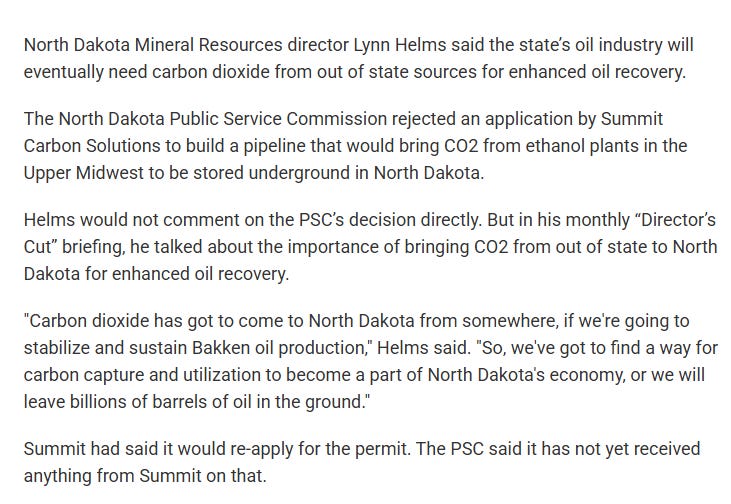
Summit as a company denied these statements as they had filled out the official paperwork saying it was for sequestration not EOR:

Then, a year later, the message was that the pipeline “could serve the oil industry” after all:

While this discrepancy in messaging was going back and forth, South Dakota slammed the door shut on the potential for the pipeline to go through their state at all:


All of which brings us to the last month of activity.
In early March, a North Dakota judge ruled that North Dakota itself issued the carbon sequestration permits in an unconstitutional manner:
A North Dakota judge has revoked Summit Carbon Solutions’ permits for underground carbon dioxide storage, ruling parts of the state law they were issued under is unconstitutional, in another blow to the company’s plans for a carbon pipeline network.
The latest ruling was issued in response to an appeal by a group of landowners who object to the state’s attempt to force them to participate in Summit’s project, which would store carbon dioxide under their land against their will.
“This decision stands as an important victory not only for our family, but for all North Dakota landowners who believe that private property rights and constitutional protections still matter,” said Kurt Swenson, one of the landowners.
The decision written by South Central Judicial District Judge Jackson Lofgren is the second time this winter a North Dakota judge has reached the conclusion that the 2009 state law violates the state’s constitution. The law authorizes regulators to permit the storage of carbon dioxide beneath the property of nonconsenting landowners.
This ruling, if upheld by the North Dakota Supreme Court would make the entire pipeline fight irrelevant since the premise of the pipeline was carbon sequestration in the first place.
Which brings us to yesterday when it was reported in Successful Farming Magazine that Summit will now try to get the pipeline approved for EOR (Enhanced Oil Recovery) afterall:

Summit now says its pipeline will be used to drive domestic oil and gas production in a process known as enhanced oil recovery (EOR), which injects CO2 gas into wells. The gas mixes with oil in the rock pores to produce a thinner, easier-to-pump fluid, potentially doubling the amount of oil that can be extracted from a reservoir.
Just a few years ago, Summit’s website stated that the project wouldn’t be used for EOR. Instead, it advertised the pipeline as a way to cut emissions through underground sequestration. Soon after, Summit heralded it as a critical step in developing lower-carbon sustainable aviation fuel.
But as the company struggles to advance its pipeline out of a permitting quagmire and faces legal battles over property rights in Iowa, North Dakota, and South Dakota, it finds itself in a starkly different energy market and political landscape.
The company’s messaging now parallels President Donald Trump’s “drill, baby, drill” policies, which seek to bolster American fossil fuel production while reversing progress on renewable energy and loosening restrictions on the greenhouse gas pollution damaging the climate.
The question is: how does it plan to do this?
The bill, which passed the Iowa House in January with a 64-28 vote, was landowners’ and the Iowa House’s answer to Reynolds’ request in 2025 for a “clean, simple bill with (no) unintended consequences relating to carbon dioxide pipelines,” Peg Rasmussen, a landowner in Montgomery County said.
The bill as advanced through the House would have banned the use of eminent domain for the construction of carbon dioxide pipeline projects. But the measure was amended during the Senate committee process, including language similar to Senate Majority Leader Mike Klimesh’s proposals that would allow for the use of eminent domain in hazardous liquid pipeline projects, if the operator has “diligently exhausted” other possibilities to find willing land easements within a widened corridor.
There’s been no action on the bill since the Senate committee vote Jan. 28.
“Sen. Klimesh said (eminent domain) was a priority in this session, bringing House File 2104 to a full committee vote — yet, here we are today,” Rasmussen said. “Instead of bringing House File 2104 to the Senate for debate on the floor and a vote, Sen. Klimesh prioritized a horse. So it’s time to get back on track. We’ve led the Senate to water, now it’s time for them to take a drink.”
There is still a threat that federal over-reach on this issue is still in play as an option to over-ride all the states involved in the process:

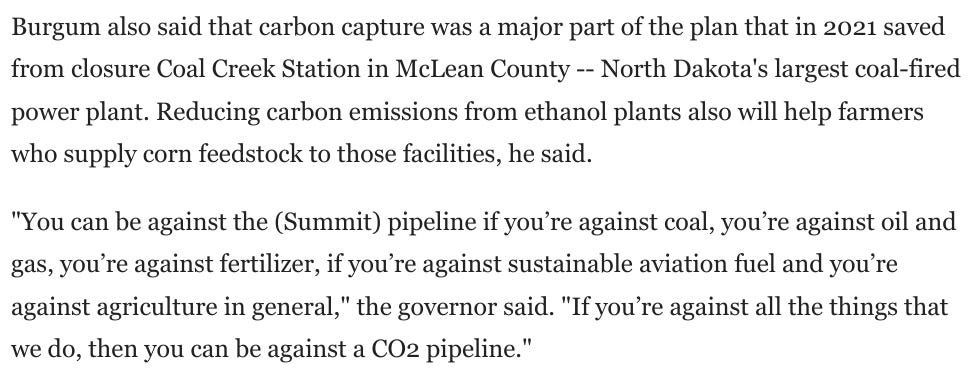
Afterall, then governor and now Secretary of Interior Doug Burgum said: